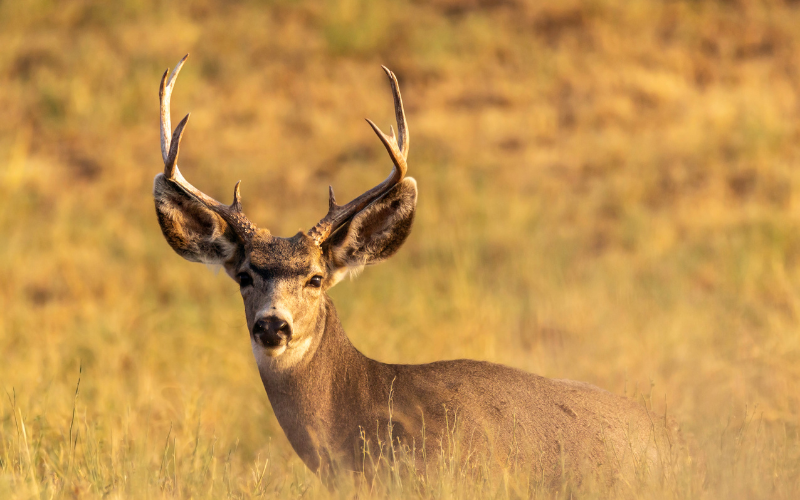
Something unusual is happening off the coast of Southern California. A plan to wipe out every mule deer on Catalina Island has brought together groups that rarely see eye to eye. Hunters who've pursued these animals for decades are standing alongside animal rights activists, both demanding answers about why state officials approved what they're calling an unnecessary extermination.
The California Department of Fish and Wildlife signed off on the controversial Restoration Management Plan on January 30th. The blueprint, submitted by the Catalina Island Conservancy which controls 88 percent of the island's land, authorizes sharpshooters to eliminate the entire deer population over the next five years. According to the Conservancy, roughly 1,800 mule deer currently roam the island, and they claim this number cannot be controlled through hunting alone.
But the numbers themselves have become a flashpoint in the growing controversy.
Counting Deer in the Dark
The Conservancy arrived at its population estimate using spotlight surveys. Teams drive island roads after dark, counting the reflective glow of deer eyes caught in their beams. They then use these roadside counts to estimate deer across the entire island. Critics say this method has serious flaws.
Charles Whitwam, founder of HOWL for Wildlife, investigated these counting methods while producing "Killing Catalina," a feature-length documentary that premiered on the island just two days before state officials approved the eradication plan. His team flew thermal drones during filming and discovered something the spotlight surveys missed.
"We saw that deer populations were not uniform across the island," Whitwam explains. The revelation calls into question whether extrapolating from roadside counts provides an accurate picture of the actual deer population.
Beyond the disputed headcount, hunting advocates point to another problem: The Conservancy never implemented a serious management strategy before requesting permission to eliminate the herd entirely.
When Success Gets Called Failure
The hunting history on Catalina Island stretches back nearly a century, beginning sometime after mule deer were brought to the island during the 1930s. For most of that time, hunting remained limited to island residents, their guests, and those willing to hire local guides. This changed in 2020 when the hunt opened to the public on a do-it-yourself basis.
Between 2010 and 2023, the Conservancy allocated approximately 500 Private Land Management tags annually through the California Department of Fish and Wildlife. Then in 2024, the state wildlife commission doubled that number to 1,000 tags. Hunters used 750 of those permits and successfully harvested 379 deer.
The mathematics tell an interesting story. If the Conservancy's population estimate of 1,800 deer holds true, hunters removed 22 percent of the herd in a single season. Previous years saw harvest rates closer to 13 percent. By most wildlife management standards, removing more than one-fifth of a population in one year represents significant impact.
The Conservancy labeled the effort a failure. They subsequently reverted to a locals-only hunt format.
"Why are you paying sharpshooters to knock deer back when hunters would do it?" asks Brian Lynn, vice president of the Sportsmen's Alliance. "They would pay to do it, and they would eat the meat."
The criticism goes deeper than economics. According to Whitwam and local outfitter Ben Myhre, who guides roughly 70 percent of the island's hunts, the Conservancy never made harvesting does a priority. Myhre told Whitwam that targeting female deer was never a requirement for hunters on Catalina. The harvest data backs this up, showing that bucks have consistently been taken with the permits while doe harvest received little emphasis.
For wildlife managers, this detail matters. Removing females from a population has far greater impact on herd numbers than harvesting males. A serious management plan focused on population reduction would prioritize doe harvest. The fact that this wasn't required raises questions about whether the Conservancy genuinely attempted to manage the herd through hunting before pursuing eradication.
Strange Bedfellows in Opposition
The coalition forming against the eradication plan represents one of the most unusual environmental alliances in recent memory. Hunting organizations that typically clash with animal welfare groups have found common ground. Both want the deer to stay, though their reasoning differs.
Dianne Stone, an advisor and historian for the Catalina Island Humane Society, has publicly called the plan "immoral" and "unnecessary." In a statement that would have seemed unlikely just months ago, representatives from the Humane Society have voiced support for hunting as the better alternative to eradication.
"We're fine with hunting, and that's the best option," Humane Society representatives stated in the documentary. "We want ethical hunting."
Whitwam describes the coalition as unprecedented. "People on all sides of the political and environmental spectrum have come together to oppose eradication," he says. The unity reveals how the eradication plan has struck a nerve that transcends traditional conservation politics.
Lynn expresses surprise that state officials approved the plan despite widespread opposition. The timing has raised eyebrows too. The Department of Fish and Wildlife signed the Restoration Management Plan around the same time "Killing Catalina" premiered on the island, bringing fresh public attention to the controversy.
The Ecological Argument
Supporters of eradication frame the issue as a matter of ecological necessity. The Conservancy and its allies argue that mule deer damage Catalina Island's environmental health and increase wildfire danger through their grazing patterns and impact on vegetation.
Scott Morrison, conservation and science director for the Nature Conservancy California, put it bluntly in an interview with CBS News: "Catalina Island can either have a functional biodiverse ecosystem or it can have deer. It cannot have both."
Lauren Dennhardt, senior director of conservation for the Catalina Island Conservancy, told the Los Angeles Times that the stakes justify the action. "We know what's at stake here," Dennhardt said. "It's important for us to essentially do the right thing to make sure that this island stays and gets even better in the future."
The Conservancy classifies mule deer as invasive, given their introduction to the island in the 1930s. But Whitwam disputes this characterization, noting that California wildlife managers have never officially classified Catalina's mule deer as invasive species. The deer remain classified as a public resource of the state, which raises questions about the authority to eliminate them entirely rather than manage their numbers.
The island's bison herd presents another wrinkle. These animals are also non-native, introduced to Catalina for a movie production in the 1920s. How bison will be treated under the Restoration Management Plan remains unclear, adding another layer of confusion to the conservation strategy.
The Devil in the Details
The execution plan has evolved under pressure. An earlier version of the Restoration Management Plan called for aerial culling, with shooters firing from helicopters. Island residents, most of whom live in the town of Avalon, raised enough concerns that this approach was scrapped. The current plan limits sharpshooters to ground-based operations.
The Conservancy still intends to hold a locals-only hunt beginning in September, though the available tags have been capped at just 200. When the professional culling will begin remains uncertain, but the timeline calls for completion within five years.
Geography and politics may complicate these plans. The city of Avalon and an entity called the Island Company own 12 percent of Catalina Island. Avalon's leadership opposes the eradication plan and has passed ordinances prohibiting the killing of deer within city limits.
For deer living in town, the Restoration Management Plan calls for tranquilizing the animals, then either euthanizing them or performing surgical sterilization. This approach presents logistical challenges and questions about feasibility on any meaningful scale.
Avalon officials are formally filing objections to the permit and the eradication plan. Multiple lawsuits from other opposition groups are reportedly in the works. The legal challenges could delay or derail implementation even as the approved plan moves forward on paper.
Questions About the Agency
Perhaps the deepest concern among critics involves the California Department of Fish and Wildlife itself. As the state's scientific authority on wildlife management, the agency's silence on key questions has troubled those on both sides of the hunting debate.
"It all just stinks to high heaven, honestly," Whitwam says. "For our department, who should be the scientific authority over wildlife, to be completely silent on this, it really poses a bigger problem. Like, what's going on with our agency that we trust to manage our wildlife? And what are they basing their decisions on?"
The questions cut to the heart of modern wildlife management philosophy. For over a century, the North American Model of Wildlife Conservation has operated on the principle that wildlife belongs to the public and should be managed for the public benefit. This model prioritizes sustainable use over elimination, even for non-native species that cause ecological problems.
The transition from management to eradication represents a fundamental shift in approach. Wildlife biologists typically view complete removal as a last resort, used only when a species poses such severe threats that no other option exists. Whether Catalina's mule deer meet this threshold remains hotly contested.
Critics point out that proper management was never seriously attempted. Harvest quotas weren't structured to maximize doe removal. Population surveys relied on methods that may have significantly overstated deer numbers. Alternative approaches like expanded public hunting, longer seasons, or different permit structures were apparently not explored in depth before jumping to eradication.
The lack of transparency around these decisions has fueled suspicion. When the scientific authority charged with protecting public wildlife resources approves an elimination plan without extensive public explanation of why management won't work, it creates space for doubt about the process and the motivations behind it.
What Happens Next
The immediate future holds continued conflict. Legal challenges are mounting. Public opposition shows no signs of fading. The documentary "Killing Catalina" continues to raise awareness and questions about the approved plan.
Meanwhile, the September locals-only hunt approaches with its dramatically reduced quota of 200 tags, down from the 1,000 offered in 2024. This reduction sends a clear signal that hunting is being phased out rather than expanded as a management tool.
The city of Avalon's resistance adds a wild card to the equation. If Avalon maintains its prohibition on deer killing within city limits, and if deer take refuge in these protected zones, the eradication plan could face practical impossibility regardless of its legal status.
The broader implications extend beyond one island's deer herd. How this conflict resolves could set precedents for wildlife management on other islands and public lands across California and beyond. The question of whether non-native species must be completely eliminated or can be managed as sustainable populations affects countless situations nationwide.
For now, the unlikely coalition of hunters, animal welfare advocates, and island residents continues pushing back against a plan they see as premature and unnecessary. They argue that the deer can and should be managed rather than eliminated, that the science justifying eradication hasn't been adequately demonstrated, and that the public deserves better answers from the agencies entrusted with wildlife stewardship.
Whether those arguments will prevail in court or in the court of public opinion remains to be seen. But the fight over Catalina Island's mule deer has already accomplished something remarkable: bringing together people who rarely agree on anything to stand united against what they view as a deeply flawed approach to a solvable problem.
The outcome will say something important about how California values wildlife, who gets to make decisions about animals that belong to the public, and whether elimination becomes the default answer when management gets complicated. For everyone watching this unfold, the stakes extend far beyond the shores of one island off the California coast.


