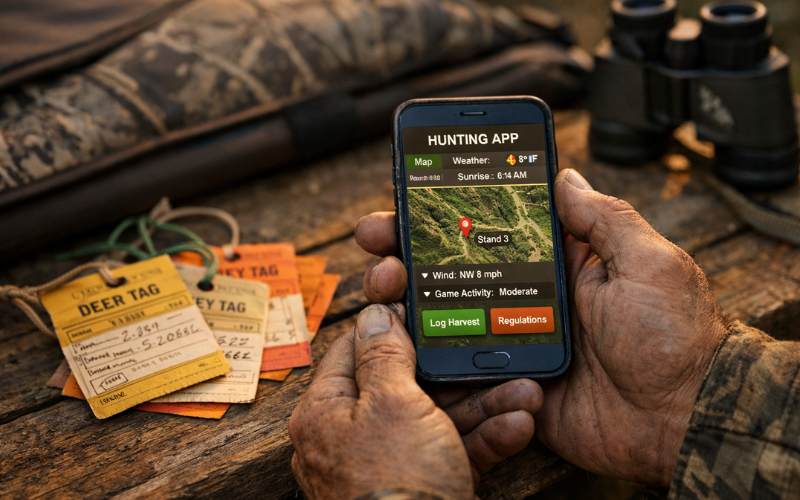
Michigan's hunting community is about to experience a shift in how they document their harvests. Come March 1, hunters across the state will have the option to ditch their paper kill tags in favor of a digital alternative, marking a significant change in a tradition that's been around for decades.
The Natural Resources Commission gave the green light on Wednesday to allow electronic kill tags for deer, bobcat, bear, fish, marten, and otter. It's a move that builds on a pilot program the Michigan Department of Natural Resources ran for turkey hunters starting last fall.
For anyone who's ever frantically searched their truck or hunting gear for that small piece of paper right when they needed it most, this change might feel like a welcome relief. The DNR reports that 27,475 hunters lost their paper licenses in 2024 alone and had to shell out money for replacements. That's a lot of frustrated sportsmen digging through pockets and glove compartments.
The Practical Side of Going Digital
The switch to electronic tags isn't just about convenience, though that's certainly part of it. The DNR expects to save money by cutting down on printing and distribution costs. Instead of waiting for tags to arrive in the mail or making a trip to a license agent, hunters can now purchase tags online through the Hunt Fish mobile app right up until they head out.
Here's how it works once you're in the field: After making a kill, you open the app and validate your harvest by answering a few questions. Don't have cell service out in the woods? Not a problem. You can fill out the information on your phone, and it'll upload automatically once you reconnect to a network or WiFi.
When a conservation officer asks to see your tag, you simply pull up the app. Even if you haven't had service since validating your kill, the information stays right there on your phone for inspection.
What About Dead Batteries and Other Real-World Problems?
Anyone who's spent time in the field knows technology can fail at the worst possible moment. So what happens when your phone dies?
Conservation officers can run your ID to verify you purchased a tag and check what type it was. If you managed to upload your validated tag before your battery gave out, they'll be able to see that information in the system.
There's another scenario many hunters will recognize: you're not always standing right next to your harvest. Maybe it's hanging at a buck pole, or a buddy is driving it to the processor for you. In these situations, you'll need to create a physical tag from durable material, write your hunting license number on it with permanent ink, and attach it to the carcass.
The rules do have some flexibility built in. If the head has been removed from the carcass, the physical tag only needs to stay with the head. Animals stored at your primary residence don't need a tag attached. And once a commercial processor or taxidermist accepts and records the carcass or head, you can remove the physical tag.
Disease Testing and Official Seals
Michigan takes disease surveillance seriously, particularly when it comes to bovine tuberculosis and chronic wasting disease in certain counties. If you're taking your deer to a disease sample submission site and you're using an electronic tag, the facility can use the information from your phone—the same details that would appear on a paper tag—to process your drop-off. The station then tags your sample for tracking during the testing process.
For hunters going after bobcat, fisher, marten, or otter, there's an additional requirement: getting an official DNR seal attached to the pelt. With electronic tags, you'll present your digital tag at the registration station to receive the seal. The system has safeguards to prevent someone from using the same electronic tag to register multiple animals at different stations. DNR officials can detect duplicate use when they run records at the end of the season.
Michigan Joins Growing Trend
Michigan isn't exactly pioneering uncharted territory here. According to the DNR, 24 other states have already implemented apps and digital tags in some form: Arkansas, Florida, Georgia, Indiana, Kansas, Kentucky, Louisiana, Maryland, Missouri, Montana, Nebraska, New Mexico, New York, North Dakota, Ohio, Oklahoma, Oregon, Tennessee, Texas, Utah, Virginia, Washington, West Virginia, and Wisconsin.
Each state has its own approach and requirements, but the trend toward digital management of hunting licenses and tags has been building for years. It's part of a broader movement to modernize wildlife management systems while still maintaining the oversight and regulation that ensures sustainable hunting practices.
The Choice Remains Yours
Perhaps the most important detail for traditional-minded hunters: electronic kill tags are optional, not mandatory. If you prefer the old way of doing things, you can still purchase physical kill tags and pick them up at a license agent or receive them through the mail.
This choice acknowledges that not every hunter wants to rely on technology in the field. Some prefer the simplicity of paper. Others might not own smartphones or feel comfortable navigating apps. The DNR has structured this change to accommodate both camps.
For those who do embrace the digital option, the benefits are clear: no more lost tags requiring replacement purchases, the ability to buy licenses at the last minute, and one less piece of paper to keep track of in the field. For the state, reduced printing and distribution costs mean resources can be allocated elsewhere within the department.
The transition comes at a time when wildlife management agencies nationwide are looking for ways to operate more efficiently while making it easier for hunters to participate in the sport. License sales fund a significant portion of conservation efforts, and removing barriers to entry—even small ones like lost paper tags—helps maintain a robust hunting community.
As March 1 approaches, hunters will need to decide which route works best for them. Download the Hunt Fish app and go digital, or stick with the paper tags that have been part of the hunting tradition for generations. Either way, the rules of the hunt remain the same. Only the documentation changes.


