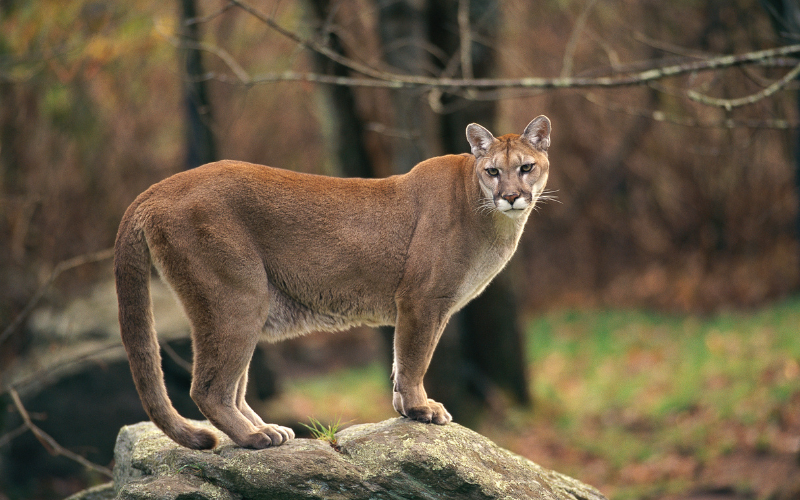
When a single mountain lion killed 23 sheep in one night on Scott Chew's ranch near Jensen, Utah, it wasn't just another livestock loss. For the fourth-generation rancher and state representative, it represented a growing problem that eventually helped reshape Utah's approach to managing its cougar population.
Two years ago, Utah became only the second state in the nation to allow year-round cougar hunting with minimal restrictions. Now, as data begins trickling in and the state launches an aggressive removal program in six regions, questions are mounting about whether these policies are protecting communities and livestock or pushing an apex predator toward dangerous decline.
A Return to Old Ways
Utah's relationship with mountain lions has come full circle in many ways. From 1888 to 1960, the state paid bounties ranging from $2.50 to $30 for killed cats. A government program called Animal Damage Control hired professional hunters specifically to protect imported livestock from native predators, killing an average of 106 cougars annually from 1913 until protections were enacted.
That changed in 1967 when Utah became among the first states to classify cougars as protected wildlife. The designation marked a significant shift in how the state viewed these large predators who play crucial roles in natural ecosystems.
But protection didn't eliminate conflicts. Chew estimates he loses about 15 sheep to cougars each year, though that number spiked to around 70 the year the old tomcat went on its killing spree. The pattern is common enough that the state maintains a "depredation account" to compensate ranchers for livestock killed by wildlife. Depending on annual funding, ranchers may only receive a percentage of each animal's value, and they never recover future earnings.
The Legislative Push
State Senator Scott Sandall from Tremonton saw mounting concerns beyond just agricultural losses leading up to 2023. "We had been seeing a number of additional cases of mountain lion to pet interaction, mountain lion to livestock interaction, and quite honestly, mountain lions and neighborhood interaction," Sandall explained. "We know that our population was increasing on mountain lions."
Whether actual population numbers supported that perception remains murky. Cougars are notoriously difficult to count. They range across vast territories, often crossing state lines, and remain largely invisible to human observers. The Utah Division of Wildlife Resources uses a technique called "population reconstruction" that analyzes the ages and genders of reported kills to estimate the adult population. One expert described it as "rock solid" but "certainly not perfect."
According to DWR's estimates, Utah's cougar population peaked in 2016 at roughly 2,000 cats, with a range between 1,800 and 2,400. The number had already been declining when legislators acted. By 2023, estimates put the population between 829 and 1,206. Current estimates suggest 900 to 1,000 cougars remain in the state.
State Representative Casey Snider, now House majority leader, noted that existing hunting laws couldn't adequately address concerns about cougar abundance. Previous attempts at reform had stalled. But with sportsmen worried about declining mule deer numbers since 2018, residents capturing cougars on home security cameras, ongoing livestock losses, and hikers filming protective mother lions on trails, momentum built for change.
On the 43rd day of a 45-day legislative session in 2023, Sandall and Snider added a provision to House Bill 469 that would fundamentally alter cougar management. Without time for public comment or House floor debate, the measure passed into law.
What Changed
The new law made "taking" cougars legal year-round. It eliminated the need for special permits beyond a basic hunting license, removed bag limits, and legalized the use of traps and snares.
Only Texas, which classifies cougars as "nongame animals" or varmints, has similarly unrestricted policies. Among the 16 states where cougars still exist, only Utah and Texas allow trapping.
Some restrictions remain. Hunters cannot kill kittens or mothers with kittens. Regulations govern how often traps must be checked and how they're identified. But the shift represented a dramatic loosening of controls.
Sundays Hunt, Utah director for Humane World for Animals, wrote in a Salt Lake Tribune op-ed that "the recreational trapping of cougars has long been prohibited — and for good reason. Cougar trapping is inherently cruel and will undoubtedly result in the nontarget captures of both wildlife and pets, including working dogs on our public lands."
Wildlife advocates weren't the only ones concerned. Some hunters and sportsmen worried about increased competition and declining populations.
The Mule Deer Connection
Last year, DWR added another controversial element to its cougar management approach. The agency reported that Utah's mule deer population of nearly 300,000 sits at only 73% of the desired 405,000.
Multiple factors influence deer numbers—drought, winter severity, disease, and roads all take their toll. But predation is another obvious piece. Through extensive research using collars on deer, DWR found that the percentage of female deer killed by cougars in several areas exceeded what they considered a sustainable 7%.
In partnership with the Utah Wild Sheep Foundation, Sportsmen for Fish and Wildlife, and the Utah Department of Agriculture and Food, DWR launched a three-year study last fall. The stated goal is "to improve the amount and quality of their habitat," according to Faith Jolley, a DWR public information officer.
The method involves "targeted cougar removals" in six hunting units: Boulder, Oquirrh-Stansbury, Pine Valley, Wasatch East, Zion, and Monroe. The state is hiring hunters and trappers to kill cougars in these areas.
Kent Hersey, DWR's big game projects coordinator, explained at a January Utah Wildlife Board meeting that the goal is understanding how cougar reduction affects deer populations across all metrics. Public hunters can still kill cougars in these units as well. "These are sometimes difficult areas to hunt," Jolley noted, "and these additional efforts ensure we have people targeted to do removals on these units."
The January meeting drew passionate opposition. After speakers—including activists, advocates, and hunters—argued against the study, audience members repeatedly applauded, prompting board chairs to call such responses "inappropriate for this meeting."
John Ziegler, chairman of the Mountain Lion Foundation and a Utah Regional Advisory Council board member, called out what he saw as serious problems. He highlighted how the study uses DWR radio collars to locate deer kill sites and facilitate contracted cougar killings, and how funding comes from deer hunting interest groups.
"Against this backdrop, allowing the predator management study to continue with the aim of removing essentially all cougars from six units is deeply controversial from a science perspective," Ziegler said. "On behalf of the Mountain Lion Foundation and the many Utah citizens who may not even be aware that this predator management study is underway and who would be strongly opposed to it, I respectfully ask that you halt the study immediately."
What the Numbers Show
Reported harvest numbers tell an interesting story. In 2021-2022, before the new law, hunters killed 476 cougars—roughly a third of the total estimated population. The first year under the new law saw 530 kills. The following year brought 501. Then something unexpected happened. In 2024-2025, only 371 cougars were reported killed.
Chad Wilson, DWR's mammal coordinator responsible for cougar management, offered several possible explanations for the drop. Last year's mild winter meant less snow for tracking. Hunters may have depleted cougars in easier hunting areas without seeking new grounds. Or, Wilson acknowledged, the population may simply be smaller.
Denise Peterson, founder and director of Utah Mountain Lion Conservation, firmly believes the third explanation. Beyond her advocacy work, she specializes in cougar mapping and habitat suitability analysis while making documentaries. Since 2017, she's been actively filming mountain lions across Utah with more than 50 cameras.
"Since that bill was signed into law, the impact wasn't immediately obvious, but this past summer in areas where we have cameras, we've seen a pretty significant decline in activity," Peterson said. "Areas that were once consistently active have now become quiet. And the fact that I haven't seen any kind of lion movement at all in several months has been very concerning to me."
While acknowledging her interpretation is anecdotal, Peterson insists it comes from extensive habitat monitoring. "There are less cats on the landscape to be able to hunt and kill," she said. "They can only sustain that level of hunting pressure for so long before they're locally extirpated from areas."
Chew and Sandall propose a different explanation rooted in hunter behavior. Chew noted his cougar hunting associates were initially upset about the new law but now appreciate the flexibility and hunt less frequently than before. Sandall heard similar accounts. When special permits limited opportunities, tag holders made dedicated efforts. Now, with year-round access, hunters can be more casual.
"Now, one of the thoughts is, because it's an opportunity that can happen anytime, people are just waiting for the opportunity," Sandall said. "And if it happens, it does. And if I don't see a lion, that's OK too."
The Female Problem
Wildlife managers have determined that no more than 40% of cougar kills can be female if the population is to sustain itself healthily. Since the law passed two years ago, females have comprised approximately 56% to 60% of reported kills, according to DWR's spring and fall Regional Advisory Council meetings.
DWR acknowledges this data. "With the year-round hunting changes, we are currently tracking the cougar harvest and monitoring the harvest of females," Jolley wrote in an email. "If we determine that cougar numbers are decreasing to a point to not sustain a viable population, we would inform the Legislature and make recommended changes. Currently, we do not have any recommended changes for cougar hunting."
With the data still unclear, Sandall argues the state needs more time. "We're probably into something of a five- to 10-year timeline to look at where the trends are and where they've gone to really discover what our takes have been," he said.
Enforcement Questions
Peterson suspects unreported hunting and trapping are occurring. Her cameras have captured adult cougars missing toes and parts of their feet, indicators of foothold traps. She's found unidentifiable traps while filming.
The Humane World for Animals obtained evidence through a Government Records Access and Management Act request of at least one kitten caught in a trap—the only unreported kill DWR was aware of at that time. The hunter, whose trap was identifiable, was found to be checking it every 48 hours as required. An investigating officer determined the incident—a kitten caught in a cougar snare and left in its habitat—to be a "freak accident."
Wilson disagrees with Peterson's broader suspicions and believes most hunters are trying to follow the law. "Like any part of life, there's those that are trying to game the system," he said. "I think most of our people are trying to be honest."
Will It Work?
David Stoner, a wildlife professor at Utah State University, said proving whether the management plan works will be expensive, time-consuming, and difficult to quantify. A successful predator management program would need to demonstrate both that it reduced predator numbers in a region and that this led to measurable benefits, such as longer female deer lifespans or more offspring.
"It can be really tough to measure these things accurately because of the large spatial extents, the difficulty of marking and monitoring animals in rugged country," Stoner explained. "Utah is a mountainous state. It's just not easy to get around. You've just got this smorgasbord of other factors that are bearing down on a population."
Still, the basic logic of killing predators to help prey species or protect communities follows an intuitive path. "There's something very intuitive about seeing an animal that kills another animal and leading to the conclusion, 'Well, there must be fewer of one species because this other one is feeding on it,'" Stoner said. "It's hard for the public not to draw the conclusion that if predators weren't there, we would have more deer, for instance."
Peterson believes this intuitive reasoning, combined with cultural attitudes, drove the policy in the first place. "It's easy to scapegoat a lion because they have sharp pointy teeth and they have this myth that surrounds them that they're these bloodthirsty predators," she said. "So, it's easy to say, 'Let's just kill these cats.' When in reality, their impact on mule deer and elk is minimal. They co-evolved with them for thousands upon thousands of years. If they were going to eat them all, they would have done it by now."
What Comes Next
Under current law, DWR lacks authority to impose caps or automatic closures on cougar hunting even if evidence suggests the need. Any substantial changes to House Bill 469 must come from state lawmakers.
Both of the law's sponsors say they're open to reconsidering if data warrants it. For now, the wildlife management experts at DWR have no recommendations for the Legislature.
The state continues to balance competing interests—ranchers losing livestock, communities concerned about safety, sportsmen wanting more deer, and wildlife advocates warning about ecosystem disruption. Meanwhile, Utah's mountain lions traverse their vast territories, mostly unseen, their actual numbers known only through imperfect estimates and the bodies that hunters report.
Sandall remains clear about one thing: the law was never meant to annihilate cougars or push them toward extinction. It aimed to address the concerns of various Utahns while maintaining population levels, perhaps with some decrease. "This law was trying a different management technique that would at least keep our population where it's at and quite honestly have some effect on some decrease in the population," he said. "For me as a legislator, when people start to say, 'Oh my gosh, what are we going to do? Our pets aren't safe. We've got a lion next to an elementary school,' people start to anticipate that we're going to have a little bit of a balancing here."
Whether that balance has been struck, or whether Utah's approach will serve as a cautionary tale or a model for other states, remains to be seen. For now, the experiment continues, with real consequences for ranchers, hunters, communities, and the cougars themselves.


