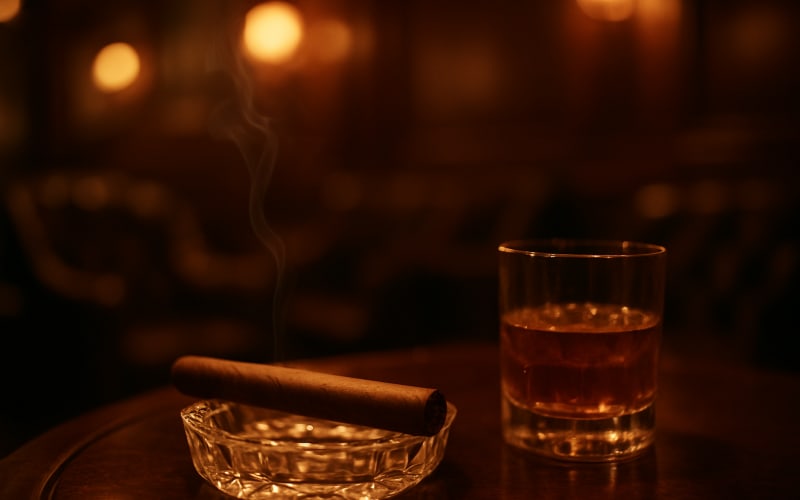
The Iowa Senate took a notable step on March 10, 2026, voting 27-18 to pass a bill that would bring licensed cigar bars to the state for the first time. Senate File 2444 now heads to the Iowa House of Representatives, and if it clears that chamber and earns the governor's signature, it would change the state's Smokefree Air Act to make room for a new kind of establishment — one where a man can sit down, light a premium cigar, and order a drink without running afoul of the law.
The vote wasn't a blowout, but 27-18 is a solid majority, and the bill now has real momentum heading into the House.
What Exactly Is a Cigar Bar Under This Bill?
Not every lounge that sells a stogie would qualify. The bill sets out nine specific requirements that a business must meet to earn the cigar bar designation, and all nine have to be satisfied — not just a few.
First, at least 35 percent of the business's revenue has to come from the sale of premium cigars and accessories. Delivery sales don't count toward that threshold, which means the 35 percent has to come from in-person business. The establishment also needs a Class C or Special Class C liquor license along with a retailer permit, which covers the alcohol side of the operation.
Age restrictions are strict. Nobody under 21 gets through the door, period. The bill requires signage at every entrance making that clear and also noting that smoking is permitted inside. That kind of transparency is built right into the requirements.
On the physical side, the business has to maintain a walk-in humidor capable of storing at least 150 cigars. That's not a small shelf in the corner — that's a real, dedicated storage space, which effectively rules out any place that's treating cigars as an afterthought.
The rules around what can actually be smoked and sold are tight as well. Only premium cigars are allowed — no cigarettes, no pipe tobacco, nothing else. And the bar cannot sell any cigar that doesn't meet the premium definition. There's also a no-food rule, which keeps these places squarely in the lounge category rather than drifting into restaurant territory.
What Counts as a Premium Cigar?
The bill spells out exactly what qualifies as a premium cigar, and the definition is fairly specific. To meet the standard, a cigar must be wrapped in whole leaf tobacco, have a 100 percent tobacco binder, and be made by hand. It cannot have a filter or a non-tobacco mouthpiece, and it has to weigh more than six pounds per thousand.
One thing worth pointing out is that handmade flavored cigars would fall under this definition. So the bill isn't limiting these lounges to traditional unflavored smokes — a flavored cigar that otherwise meets the handmade, whole leaf, no-filter criteria would be perfectly legal to sell and smoke inside a qualifying establishment.
The Penalties for Getting It Wrong
The bill doesn't leave enforcement vague. If a cigar bar is caught violating any of the nine requirements, the fines scale up quickly. A first violation runs $1,000. A second violation within 12 months doubles that to $2,000. A third violation within the same 12-month window brings a $5,000 fine. That kind of escalating penalty structure is designed to keep operators honest rather than treating early violations as cheap lessons.
What Happens Next
S.F. 2444 now sits in the hands of the Iowa House. If the House passes it, it goes to the governor. The bill is written to take effect immediately upon signing, so there would be no waiting period between the governor's pen hitting the paper and the law being on the books.
Whether the House moves quickly or lets the bill sit remains to be seen. But for anyone in Iowa who has wanted a proper place to sit down with a handmade cigar and a drink, this is the closest the state has come to making that a legal reality.
Why This Matters Beyond Iowa
Bills like this tend to get watched by other states. Iowa wouldn't be the first state to carve out a cigar bar exemption from its clean air laws — several states already have some version of this on the books — but each new state that does it adds to the case that these establishments can operate within a clear regulatory framework without creating broader public health problems.
The tight requirements in S.F. 2444 are actually part of what makes it a reasonable model. By limiting who can enter, what can be smoked, and how much of the revenue has to come from cigars themselves, the bill draws a clear line between a legitimate cigar lounge and a bar that just wants to let people smoke. That distinction matters both legally and practically.
For now, the ball is in the Iowa House's court.


